
- October 7, 2026
"The Hunger Games" Composer James Newton Howard's New Concerto Takes Center Stage in Pacific Symphony's Cinematically Inspired Concert Led by Alexander Shelley
Media Contact
Janelle Kruly Harrison
janelleh@reveilleinc.com
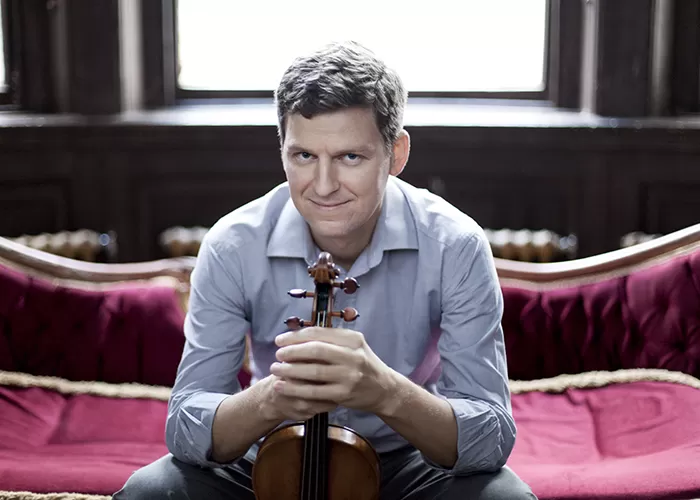
James Ehnes gives the West Coast premiere of Howard’s Violin Concerto No. 2, paired with music made famous by Disney’s “Fantasia” and “2001: A Space Odyssey”
Pacific Symphony presents the West Coast premiere of James Newton Howard’s Violin Concerto No. 2, written for internationally acclaimed violinist James Ehnes, Oct. 22–24 at the Renée and Henry Segerstrom Concert Hall. Continuing Artistic & Music Director Alexander Shelley’s thematic programming for America250, the new concerto showcases one of Hollywood’s most celebrated composers in a cinematically inspired program exploring the connection between orchestral music and visual storytelling.
“James Ehnes is a dear friend and one of the greatest violinists of our time,” said Shelley. “He will perform the West Coast premiere of an extraordinarily beautiful work by James Newton Howard, one of today’s most distinguished film composers and a valued member of our Pacific Symphony family. It’s especially fitting for this program of music inspired by the movies: James Ehnes first considered reaching out to James Newton Howard about a possible collaboration while at the movies with his now-wife, watching M. Night Shyamalan’s Signs. Ten years later, he gave the world premiere of Howard’s first violin concerto with Pacific Symphony, and now he returns to introduce his Violin Concerto No. 2.”
Best known to millions for his scores to The Hunger Games films, The Dark Knight, King Kong, The Sixth Sense and the Fantastic Beasts films, Howard has also developed a significant relationship with Pacific Symphony and the concert hall. The Symphony premiered his first concert work, I Would Plant a Tree, in 2009 and, in 2015, gave the world premiere of his first Violin Concerto, also written for Ehnes. Now Ehnes returns to Pacific Symphony for the West Coast premiere of Howard’s second concerto for the instrument.
Shelley conceived the concert around the orchestra’s extraordinary ability to create images, drama and narrative in the listener’s imagination. Paul Dukas’ The Sorcerer’s Apprentice, immortalized by Mickey Mouse in Disney’s Fantasia, opens the concert while Richard Strauss’ dramatic tone poem “Also Sprach Zarathustra”—whose iconic opening fanfare became one of the most recognizable sounds in cinema through Stanley Kubrick’s 2001: A Space Odyssey—brings the program to a spectacular conclusion.
Howard represents that idea from another direction: a composer renowned for creating music for images now brings his dramatic imagination to the concert hall, without a film or story on the screen. Together, the works reveal the unique ways composers use orchestral music to create visual images, tell stories and transport audiences to new worlds.
Mickey, Magic, and The Sorcerer’s Apprentice
Dukas’ The Sorcerer’s Apprentice is a story about magical overreach. Based on Johann Wolfgang von Goethe’s 1797 ballad Der Zauberlehrling, the work follows an apprentice who attempts to wield his master’s magic before he fully understands how to control it. The work was composed in 1897, exactly one century after Goethe’s poem, and premiered in Paris that same year. Though its essence suggests ominous and dangerous magic, Dukas’ colorful writing and orchestration give the piece a sense of wit, momentum and theatrical spectacle.
The piece became especially popular among younger generations through Disney’s Fantasia, in which Mickey Mouse plays the apprentice and uses his master’s magic to make a broom carry water before losing control of the spell and causing a flood. The pairing of Dukas’ vivid orchestration with animation helped to establish The Sorcerer’s Apprentice as one of classical music’s most familiar examples of music inspiring visual storytelling.
The Sound of a Sunrise: Strauss’ Zarathustra
Richard Strauss’ Also Sprach Zarathustra, composed in 1896 and inspired by Friedrich Nietzsche’s work Thus Spoke Zarathustra, was never intended as a literal musical translation of Nietzsche’s text. However, Strauss created a sweeping tone poem exploring philosophical and human themes through sound.
Its opening, often associated with sunrise, has become one of the most recognizable passages in orchestral music. Stanley Kubrick’s 2001: A Space Odyssey played a powerful role in this, giving the music an enduring association with space, the cosmos and human evolution and demonstrating Strauss’ cinematic imagination decades before the emergence of the modern film industry.
But the famous opening is only the beginning of Strauss’ extraordinary orchestral journey. The work offers a fitting close to the concert, creating sounds of mystery and grandeur while exploring questions of belief, knowledge and humanity’s search for understanding.
“The famous opening bars express the sun rising over a landscape, but they also represent the idea of consciousness, of awakening coming to humanity,” said Shelley. “What follows is then an exploration of the idea of religion and belief as a solution that collapses in on itself, and then we explore science and reason as a path to understanding in this world.”
The concert titled “Shelley Conducts The Sorcerer’s Apprentice and Strauss” takes place October 22–24 at 8 p.m. in the Renée and Henry Segerstrom Concert Hall. Enhancing the experience, audiences can attend a free Preview Talk at 7 p.m. A matinee performance, “Shelley Conducts Dukas and Strauss,” also takes place on Sunday, October 25, at 3 p.m. Tickets start at $36. For more information or to purchase tickets, call (714) 755-5799 or visit PacificSymphony.org.
About James Ehnes, Violin
James Ehnes has established himself as one of the most sought-after musicians on the international stage. Gifted with a rare combination of stunning virtuosity, serene lyricism, and unfaltering musicality, he performs regularly with many of the world’s leading orchestras, including the Los Angeles Philharmonic, Boston Symphony Orchestra, Chicago Symphony Orchestra and Royal Concertgebouw Orchestra. A two-time Grammy Award winner, Ehnes has also received three Gramophone Awards and 12 Juno Awards, the most of any classical musician in history. He serves as Artistic Director of the Seattle Chamber Music Society and Professor of Violin at Indiana University’s Jacobs School of Music. A Member of the Order of Canada, Ehnes performs on the 1715 “Marsick” Stradivarius.
About Alexander Shelley, Artistic & Music Director
One of the foremost conductors of his generation, Alexander Shelley is “a natural communicator, both on and off the podium” (The Daily Telegraph), appearing regularly across six continents with the world’s finest orchestras and soloists. A passionate and articulate advocate for the role of music in society, Shelley has spearheaded multiple award-winning and ground-breaking projects, unlocking creativity in the next generation and bringing symphonic music to new audiences.
With a conducting technique described as “immaculate, everything crystal clear” (Yorkshire Post), and with a “precision, distinction, and beauty of gesture not seen since Lorin Maazel” (Le Devoir), Shelley is known for the integrity of his interpretations and for his creative programming. He has led over 50 major world premieres, highly praised cycles of Beethoven, Schumann, and Brahms symphonies, operas, ballets, and innovative multimedia productions. He is admired in the industry for bringing the best possible sound out of orchestras.
In 2026-27, he leads Pacific Symphony in Southern California into a thrilling new era as its Artistic & Music Director. Additionally, this season marks Shelley’s first full season as Principal Conductor of the National Symphony Orchestra Ireland (NSOI). Shelley is Artistic and Music Director of Artis–Naples, in Florida, where he provides artistic leadership for the Naples Philharmonic and the wider multidisciplinary arts organization. Across each ensemble, Shelley is committed to presenting music as a complete artistic experience. With Pacific Symphony and Artis–Naples, he leads performances of the entire Beethoven symphonic cycle, inviting audiences into a deeper engagement with the composer’s creative vision. Read more at pacificsymphony.org/alexander-shelley.
About Pacific Symphony
Founded in 1978, Pacific Symphony welcomes Alexander Shelley for his inaugural season as Artistic & Music Director in 2026-27, building on nearly five decades of artistic growth, innovation, and community impact. His inaugural season reflects an ambitious artistic vision that blends core symphonic masterworks, contemporary voices, multidisciplinary collaboration, and a commitment to expanding access to orchestral music. Today, Pacific Symphony is recognized as a major cultural force in Southern California and performs as a resident company of the Segerstrom Center for the Arts at the Renée and Henry Segerstrom Concert Hall in Costa Mesa. Learn more at pacificsymphony.org.
###